Biolittlething is a biodesign studio, brings together a biodesigner and a materials scientist through research, experimentation & artistic making.
Biolittlething is a collaborative biodesign studio that brings together a biodesigner and a scientist through research, experimentation & artistic making.
Life In Cavities
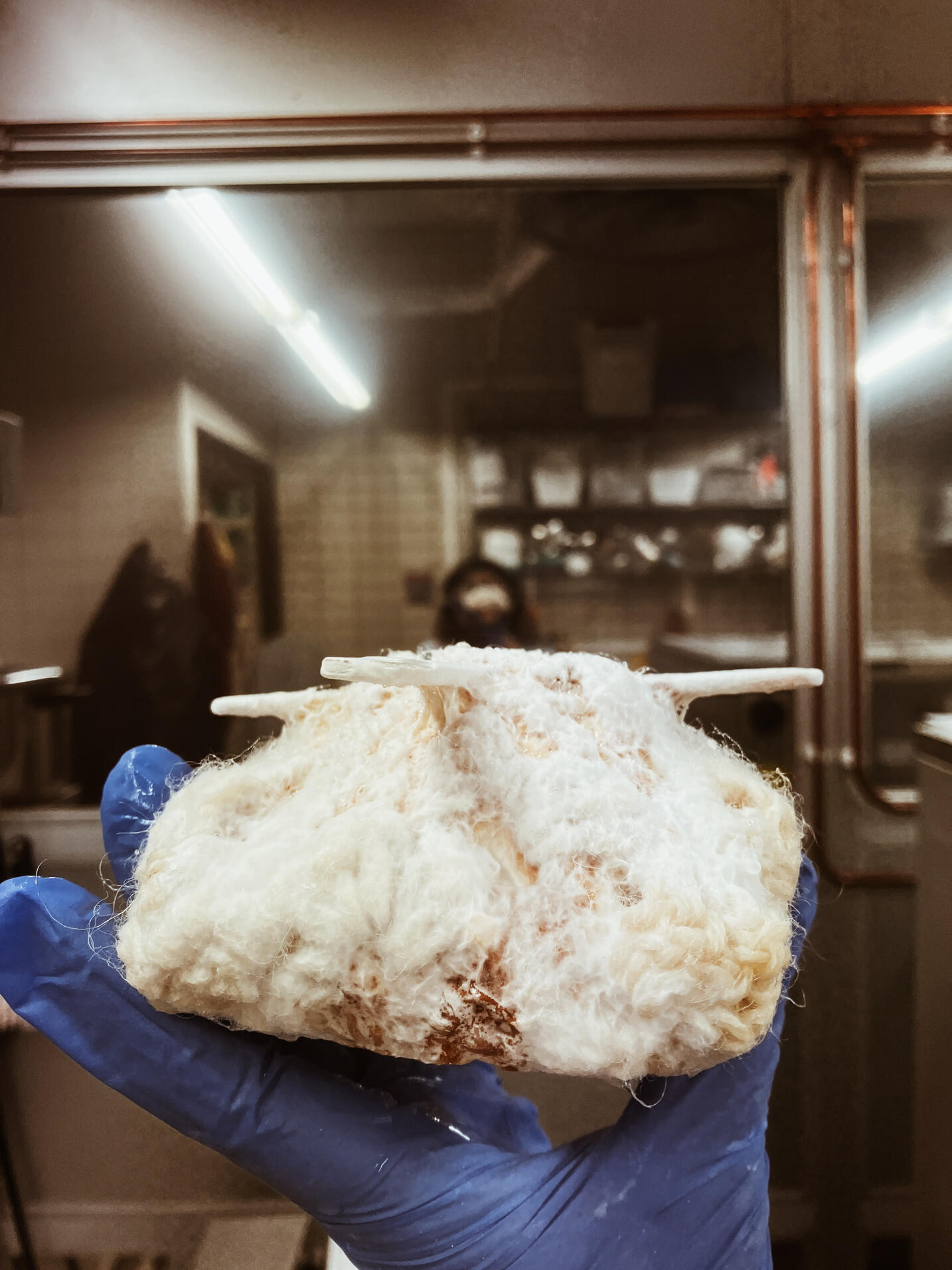
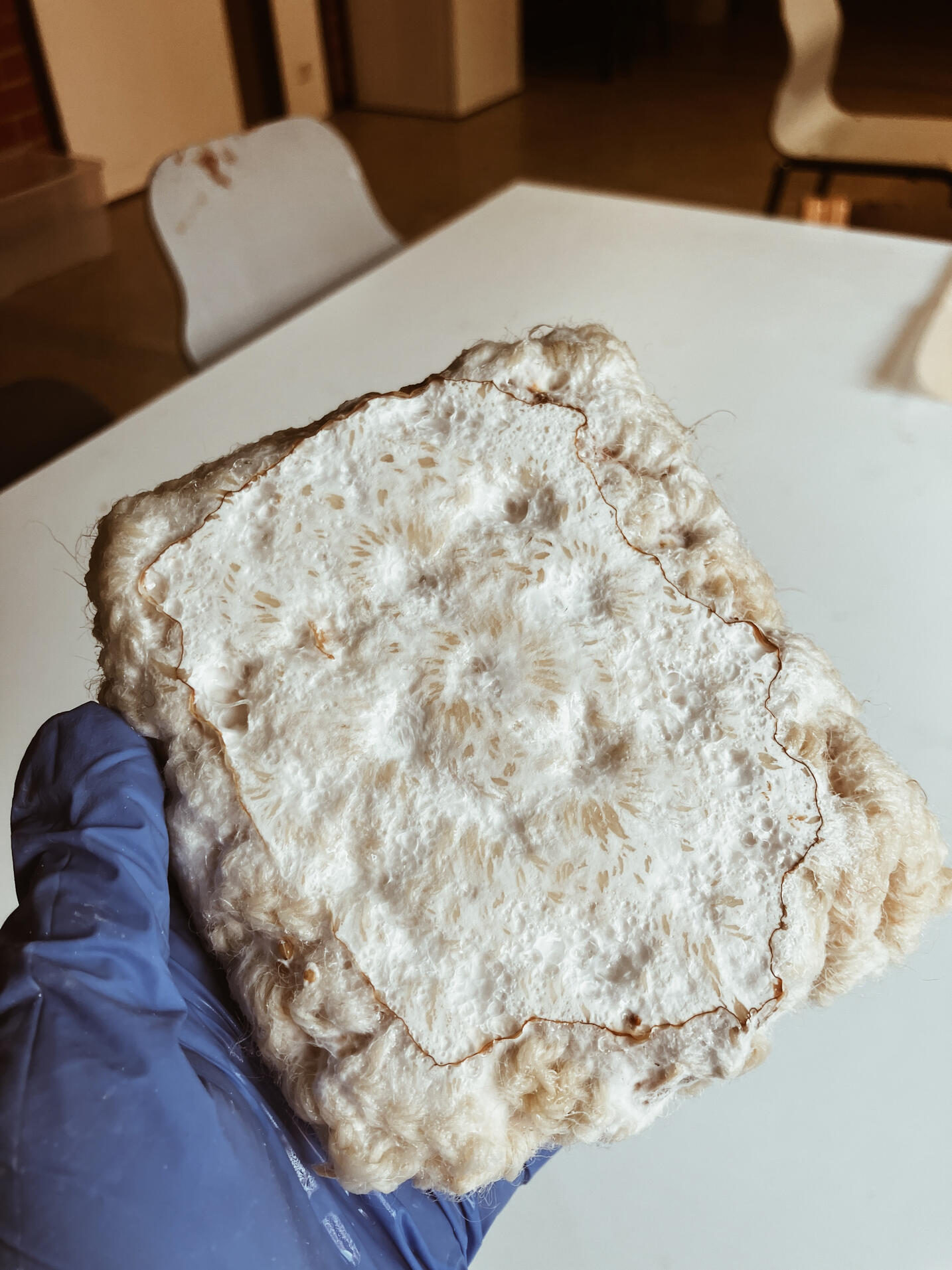
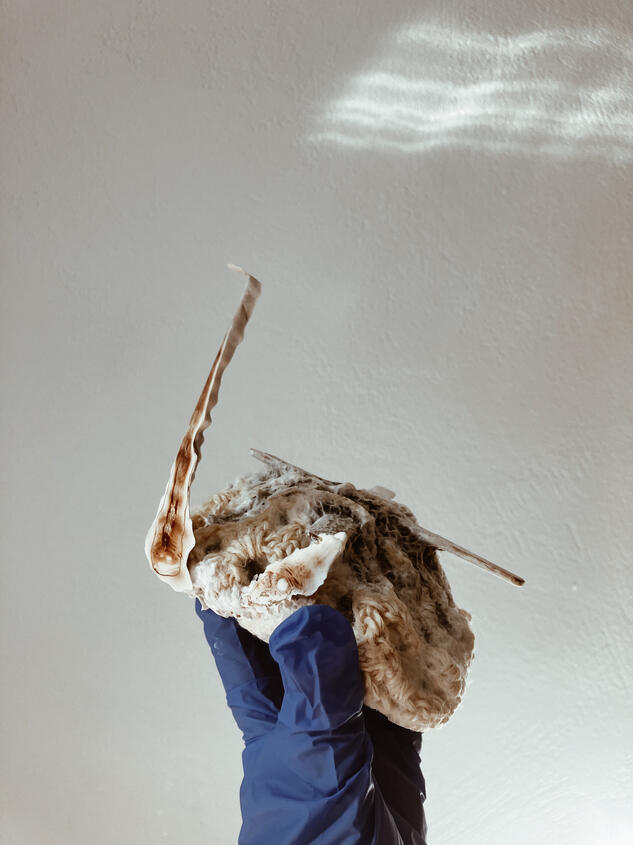
What happens when a structure offers possibilities without prescribing a form?In Life in Cavities, we used crocheted wool to create a porous body for Reishi mycelium to colonise. The open crochet contained cavities of varying sizes, leaving the organism multiple pathways to grow through and beyond its woollen skin.The growth did not follow a uniform pattern. Mycelium accumulated more densely along the lower part of the body, while the upper areas remained relatively sparse. Over time, it extended beyond the crochet structure and attached itself to the surrounding container walls. What emerged was not a continuous surface, but a body marked by contrasts between density and absence, containment and extension.These differences may have been influenced by moisture, gravity, and nutrient distribution, although the experiment did not isolate their individual effects. What we observed was that the organism did not simply fill the available cavities. It formed its own uneven pattern, extending beyond the boundaries we had initially provided.
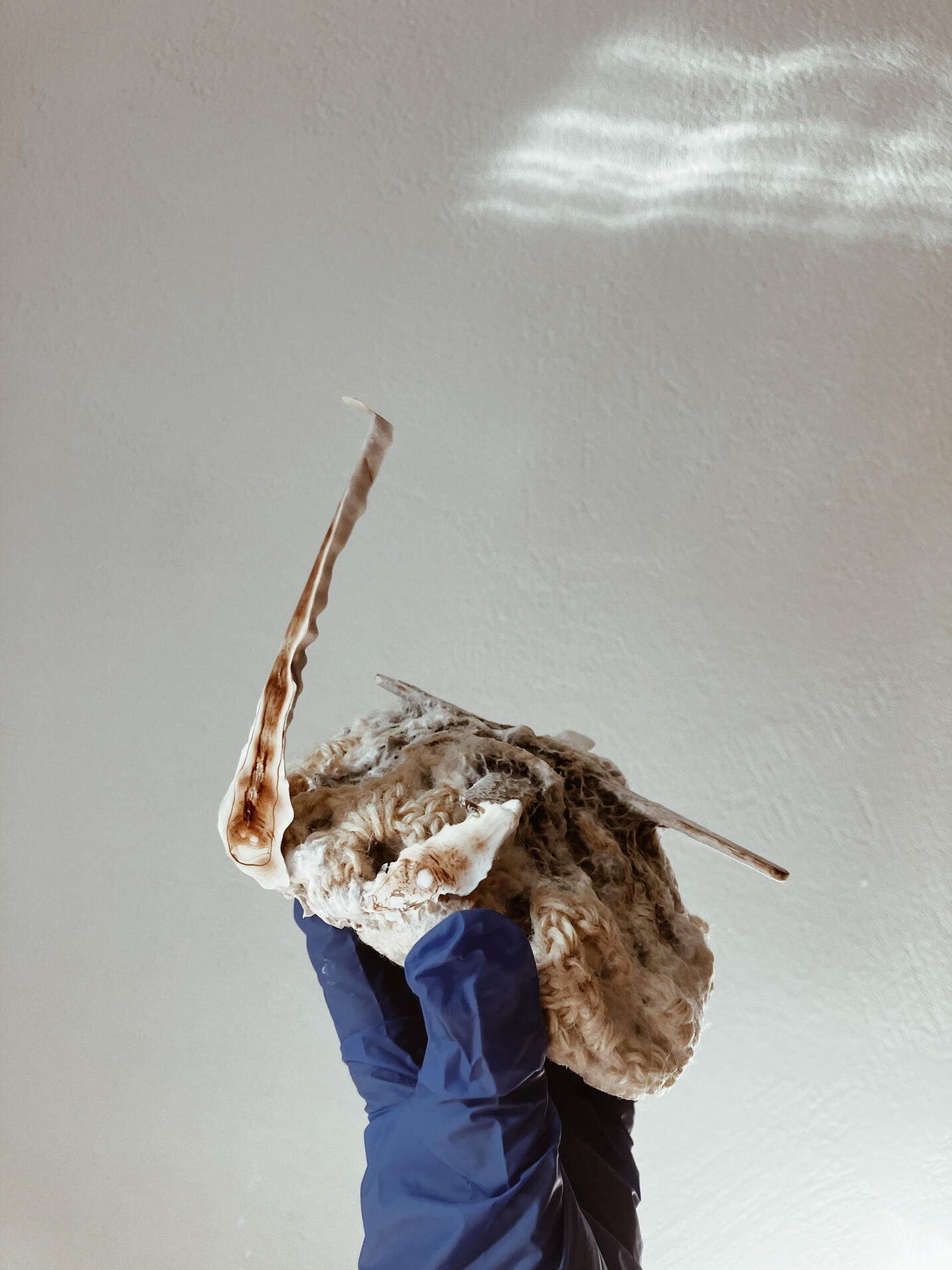
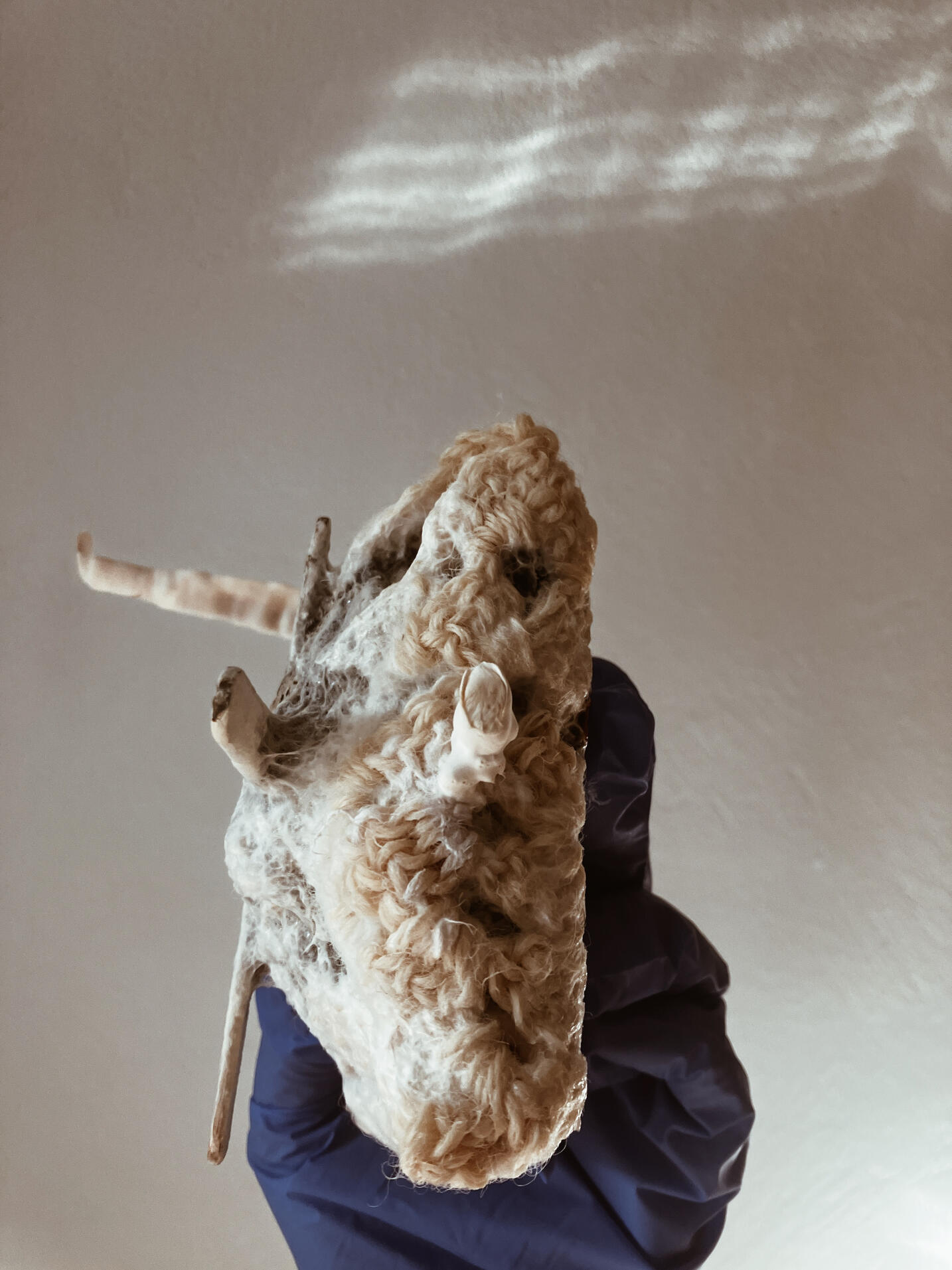
The experiment raised a question about design control. A more enclosed structure might offer greater control over the material's appearance, but it could also introduce other challenges, including contamination. Here, the open crochet structure produced an unpredictable result without visible contamination.We began to think of structure less as a prescription for form and more as a set of conditions within which growth could unfold. The crochet did not determine exactly where the mycelium should go. It offered a framework, and the organism responded in ways we could observe but not fully direct.Life in Cavities became an exploration of this tension between shaping and allowing. The resulting form was neither entirely designed nor entirely beyond design. It emerged through an encounter between the structure we made and the growth we could not fully anticipate.
Biolittlething is a collaborative biodesign studio that brings together a biodesigner and a scientist through research, experimentation & artistic making.
Myco-Doll
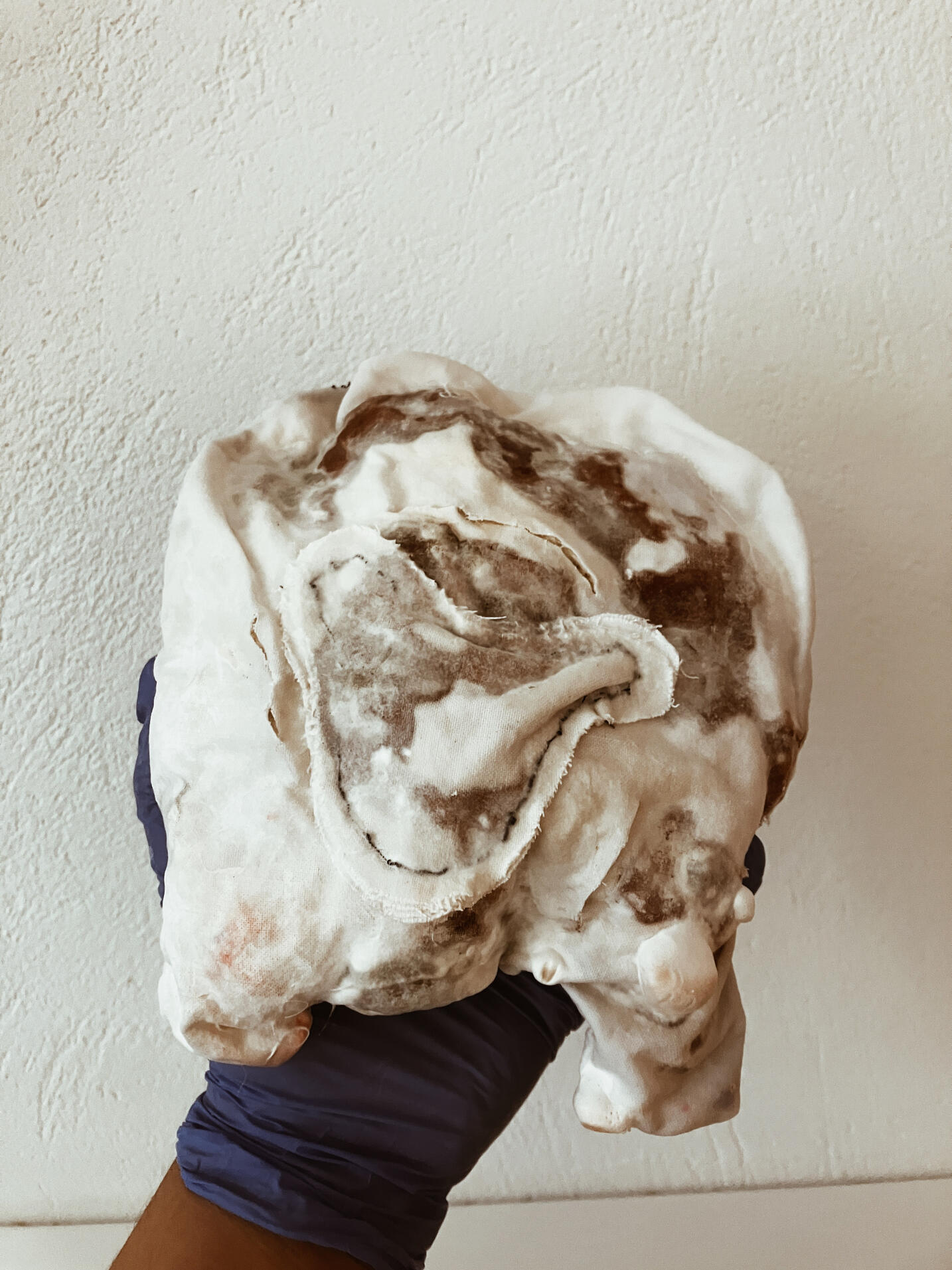
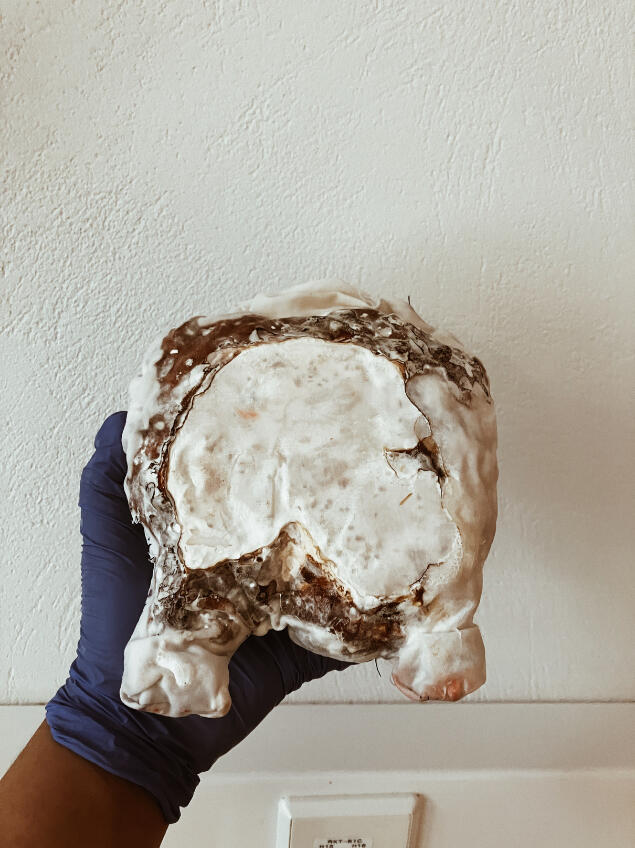
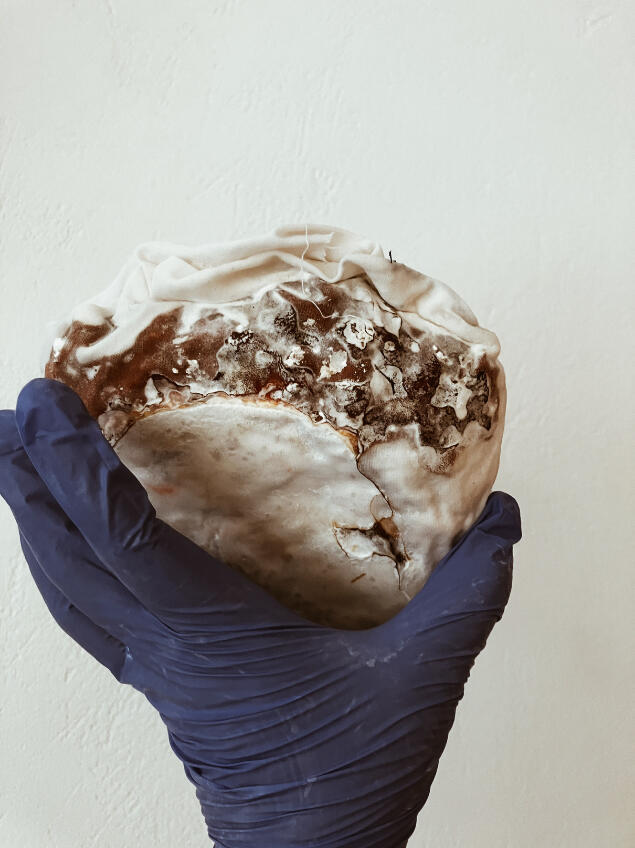
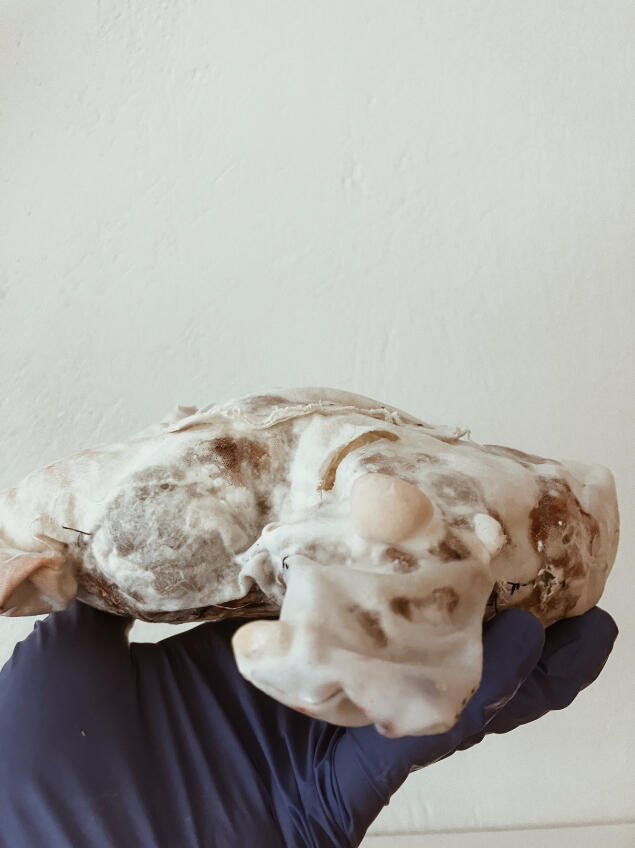
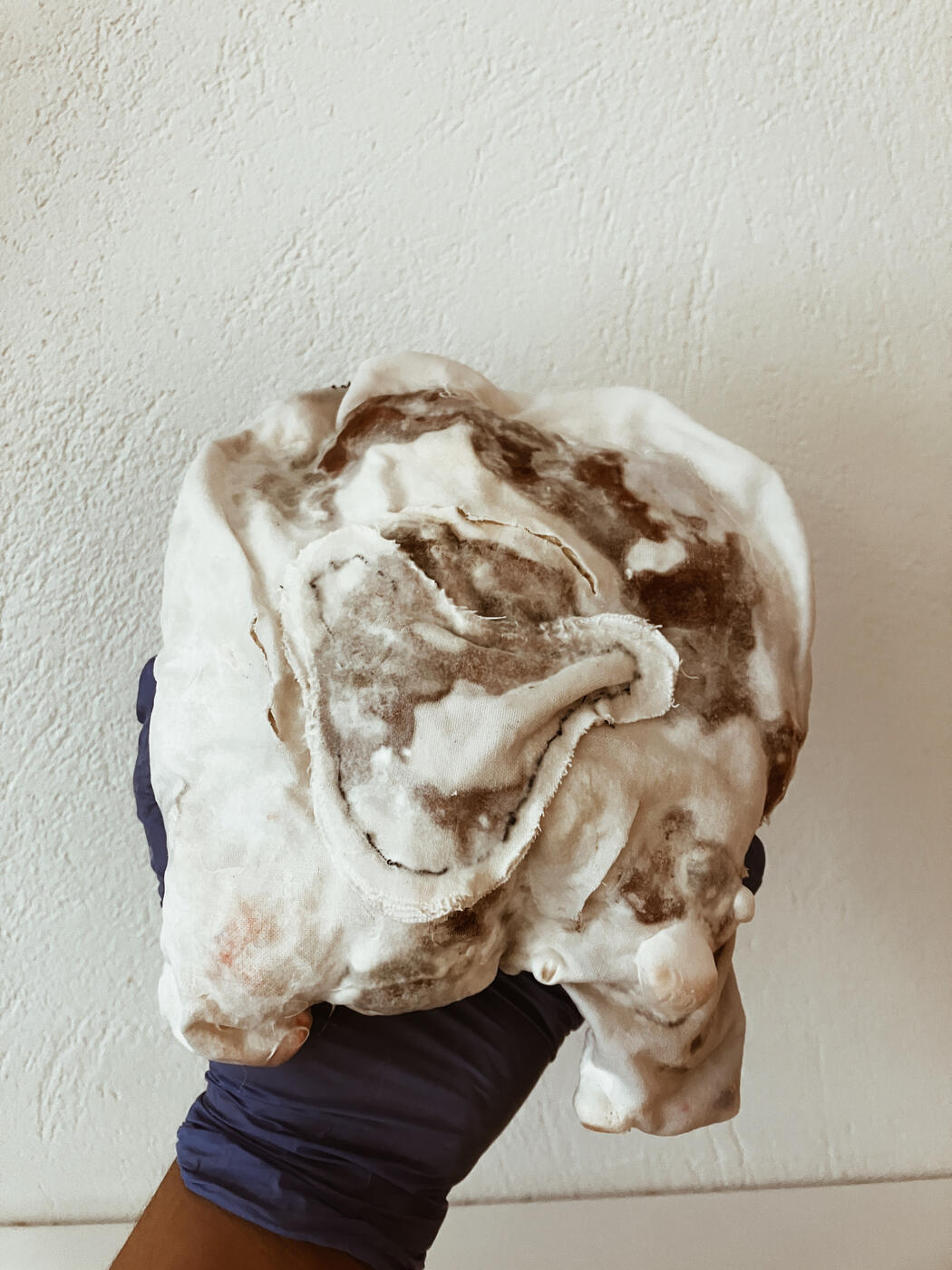
We stuffed a stitched cotton shell with raw wool and Reishi-inoculated substrate containing aspen wood chips, oats, and gypsum. The cotton served as both a mould and an outer skin, holding the material in a defined, doll-like form.As the mycelium colonised the wool, mushroom pins developed beneath the cotton surface, pressing outward and stretching the fabric fibres around their emerging forms. Rather than growing through pre-made openings, the pins gradually displaced the cotton, loosening its weave as they pushed against the skin.The Myco-Doll explored how living growth can reshape an imposed form, revealing the tension between the boundaries we construct and the bodies that grow within them.
Biolittlething is a collaborative biodesign studio that brings together a biodesigner and a scientist through research, experimentation & artistic making.
FUNGITERIA
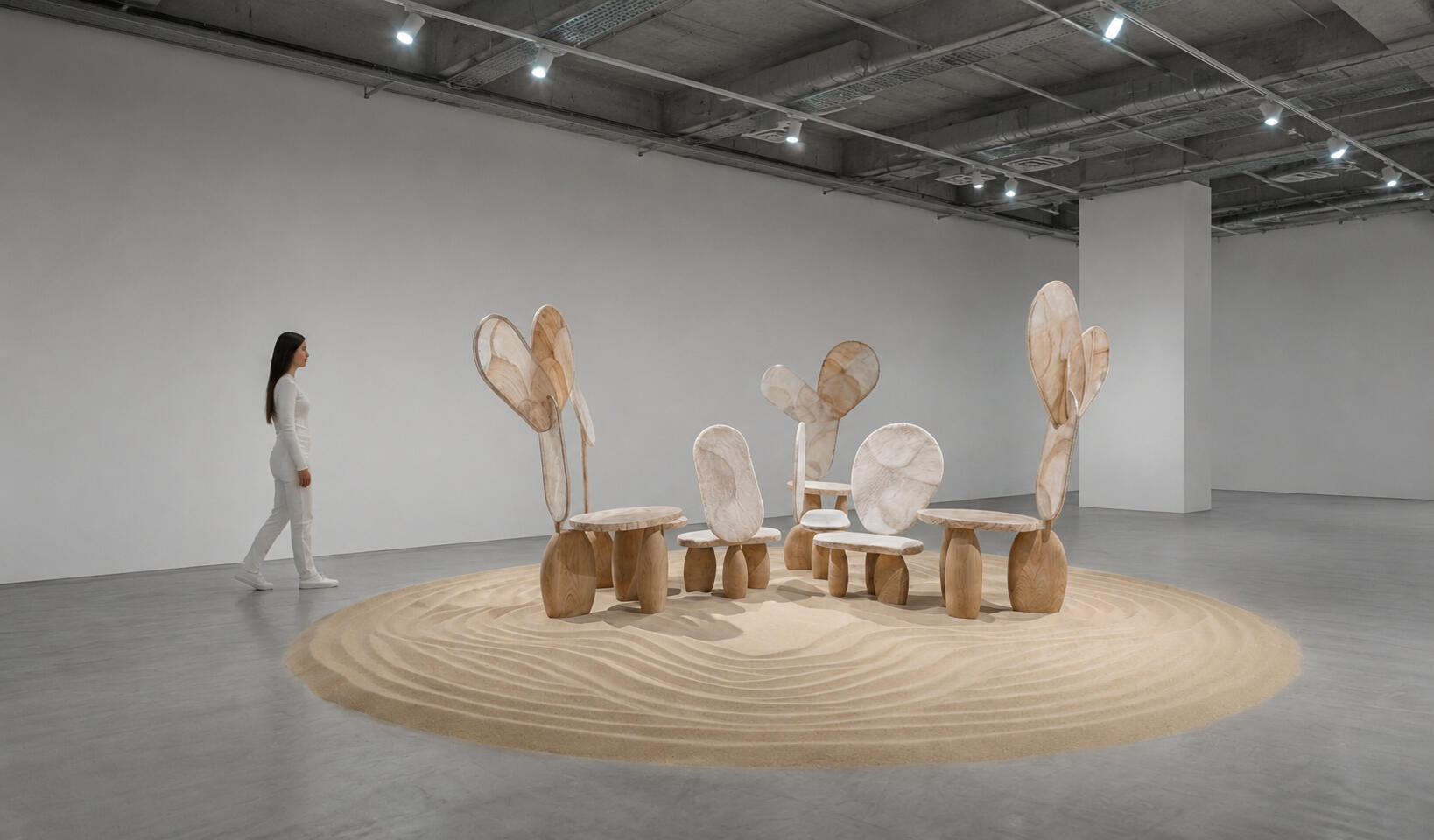
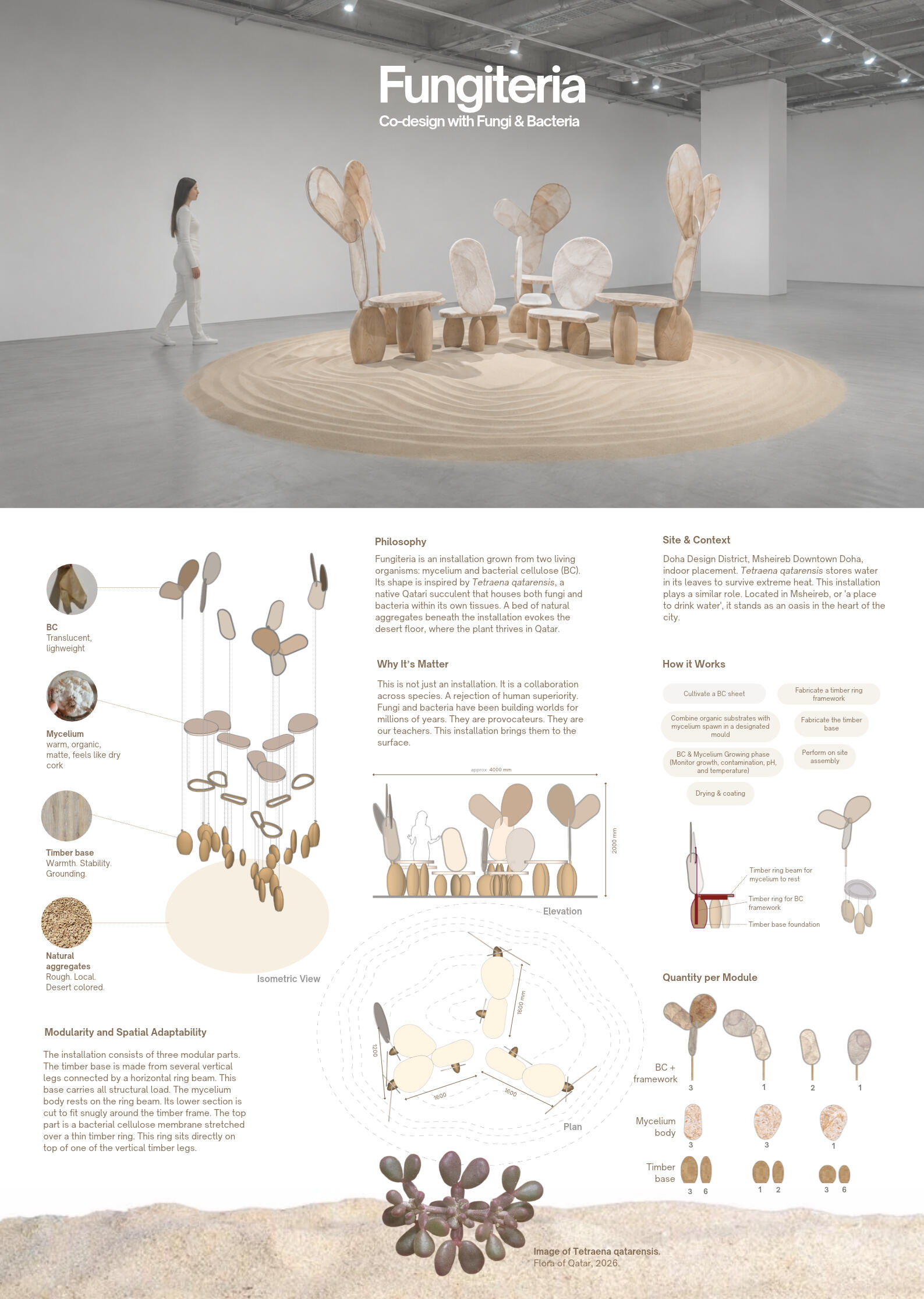
In The Martian movie, Mark Watney survives on Mars not because rescue arrives, but because he learns to grow his own food. Through soil, science, and persistence, he builds a self-sustaining system. While fictional, the premise feels increasingly relevant today.Over the past months living in Doha, we have witnessed how quickly geopolitical tensions can disrupt material flows, creating procurement uncertainty and reinforcing dependence on distant supply chains. These conditions raise an urgent question for design today: how might we shift from being passive consumers of industrial materials to active cultivators of the environments we inhabit? This perspective aligns with more-than-human design approaches, recognising that our built spaces are shared with countless forms of life, and that materials can be designed to coexist with microbial ecologies rather than exclude them.For Doha Design District Public Art Open Call, we propose an installation inspired by Tetraena qatarensis, a native Qatari plant that naturally hosts both fungi and bacteria within its tissues. The installation will be grown from mycelium and bacterial cellulose using locally sourced substrates such as date palm fronds and leaves. Through this work, we aim to question where our materials come from, how they are produced, and what relationships they sustain.We are not waiting for a rescue ship. We are learning how to grow our own.This proposal was selected among the top 20 out of 224 submissions to a Doha Design District public art open call and included in the exhibition of selected projects.
Since ancient times, humans have built directly from nature. Wood, bamboo, and stone were not simply materials, but gifts from the land. Yet these materials require time to regenerate. A tree can take decades to mature, while bamboo, often considered a faster sustainable alternative, still needs several years before it can be harvested. These are natural rhythms of growth and renewal.Today, however, we live in a culture that demands speed. We consume materials faster than ecosystems can recover. Buildings rise rapidly, products circulate endlessly, and the connection between material and time becomes increasingly invisible.
But what if there is another way? Not through faster extraction, but through faster growth. What if materials could be cultivated by organisms from the fungi and bacterial kingdoms, living systems capable of transforming waste into resources while growing within weeks rather than years?As an architect and a chemist working together, we see this process as part of a broader shift toward more-than-human design. Instead of relying solely on inanimate industrial materials, we invite microscopic organisms to become active participants in the creative process.The project invites visitors to reflect on humanity’s relationship with other species and the possibility of moving beyond human-centred design. Perhaps sustainability is not only about inventing better technologies, but also about learning when humans should step back and allow other living systems to participate in shaping the world with us.Fungi and bacteria have been building worlds for millions of years. They are architects of ecosystems, recyclers of waste, and facilitators of life itself. This installation brings them to the surface, not as invisible organisms hidden beneath the ground, but as collaborators, provocateurs, and teachers.
Biolittlething is a collaborative biodesign studio that brings together a biodesigner and a scientist through research, experimentation & artistic making.
Myco-felting I
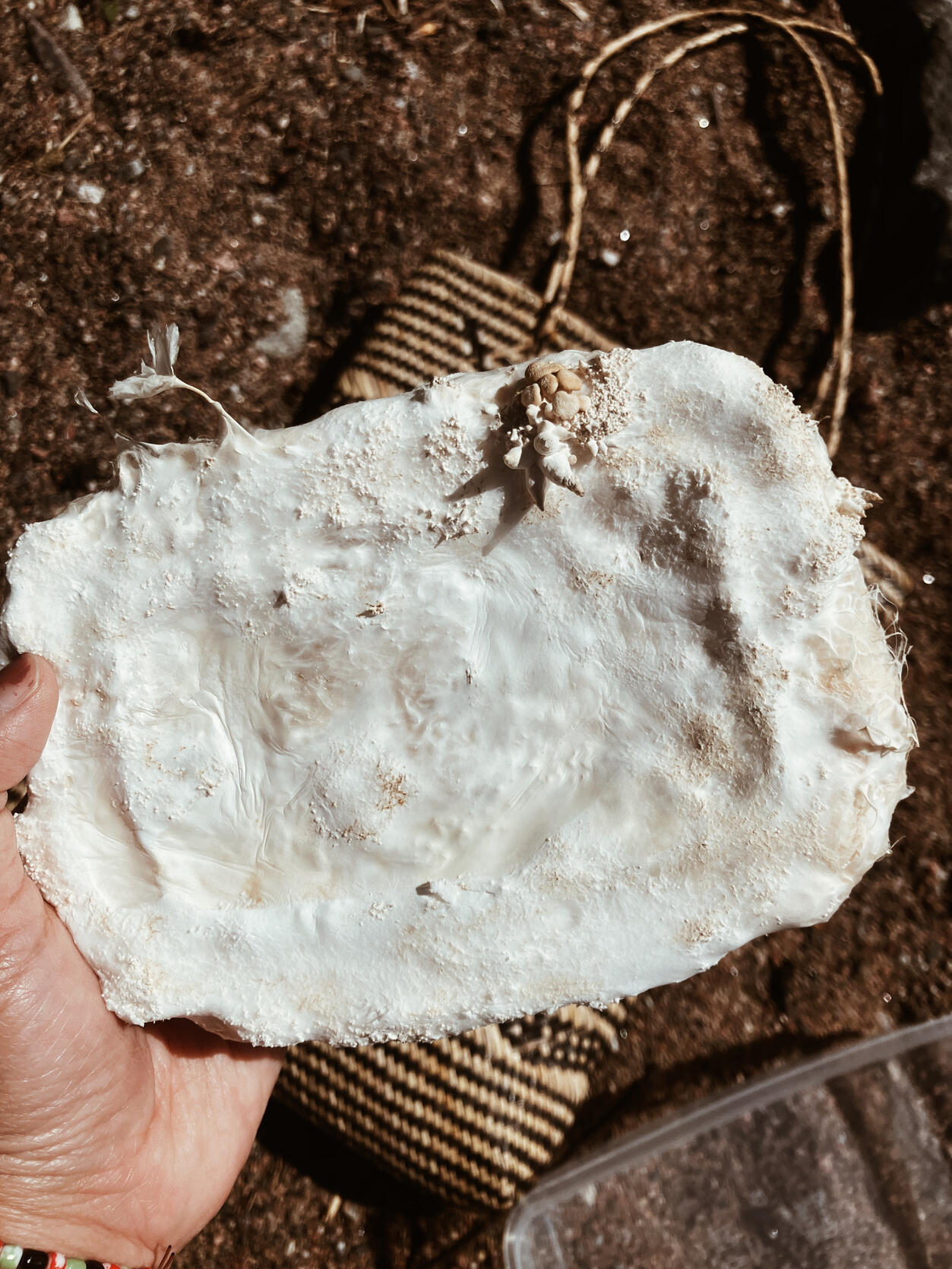
What if wool could felt itself, with the help of a living organism?Myco-felting I began as an experiment to investigate whether raw wool could support mycelial growth and become a self-binding material. We introduced Pleurotus ostreatus, commonly known as oyster mushroom, to unprocessed wool and observed its transformation over several weeks.Without carding or mechanically preparing the fibres, the mycelium gradually spread through the wool, forming a dense, cotton-like network. As colonisation progressed, the material shifted in appearance and texture. Cloudy masses gave way to delicate, web-like formations, while the fibres became increasingly entangled and bonded. The process recalled wet wool felting, but here, mycelium acted as the binding agent. The material retained moisture and developed a soft, spongy quality. Early mushroom pins appeared, but fruiting did not fully develop, partly due to difficulties in maintaining humidity.The experiment invited us to pay attention to material change as it unfolded. We watched the wool shift from a loose mass of raw fibres into something resembling a small landscape: first cloudy and dense, then threaded with delicate networks. Its earthy, damp smell and soft surface made the process tangible beyond what could be seen. The experiment became a starting point for thinking about material-making as a process of observation and negotiation, where the designer can establish conditions but cannot fully determine the outcome.
Biolittlething is a collaborative biodesign studio that brings together a biodesigner and a scientist through research, experimentation & artistic making.
Starch Matters
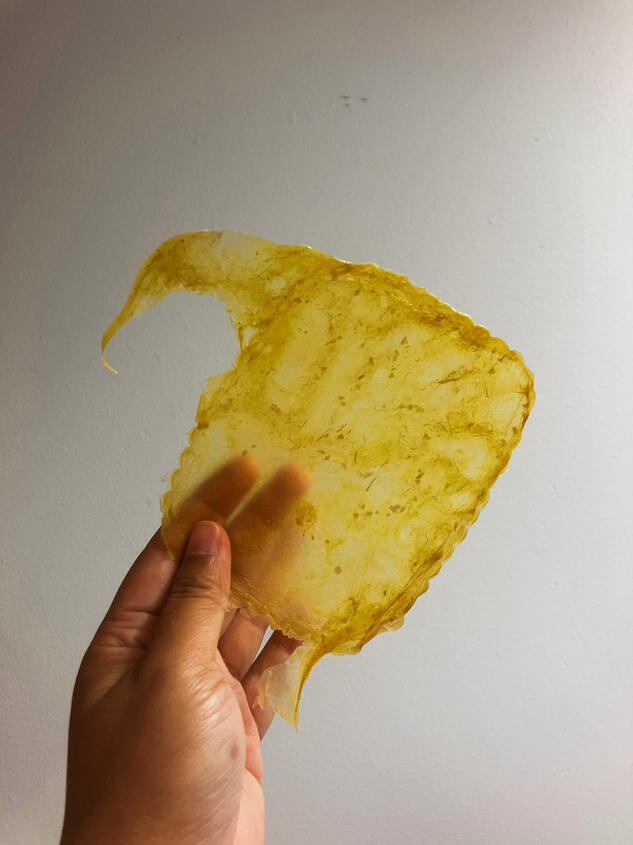
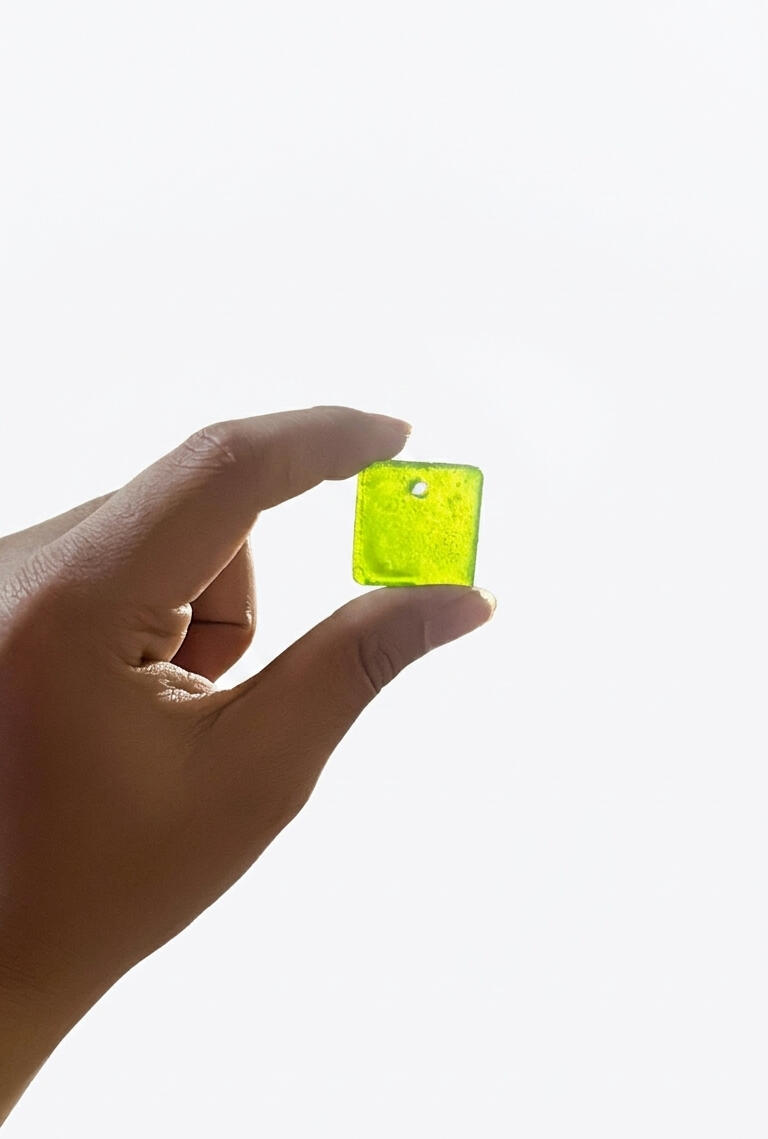
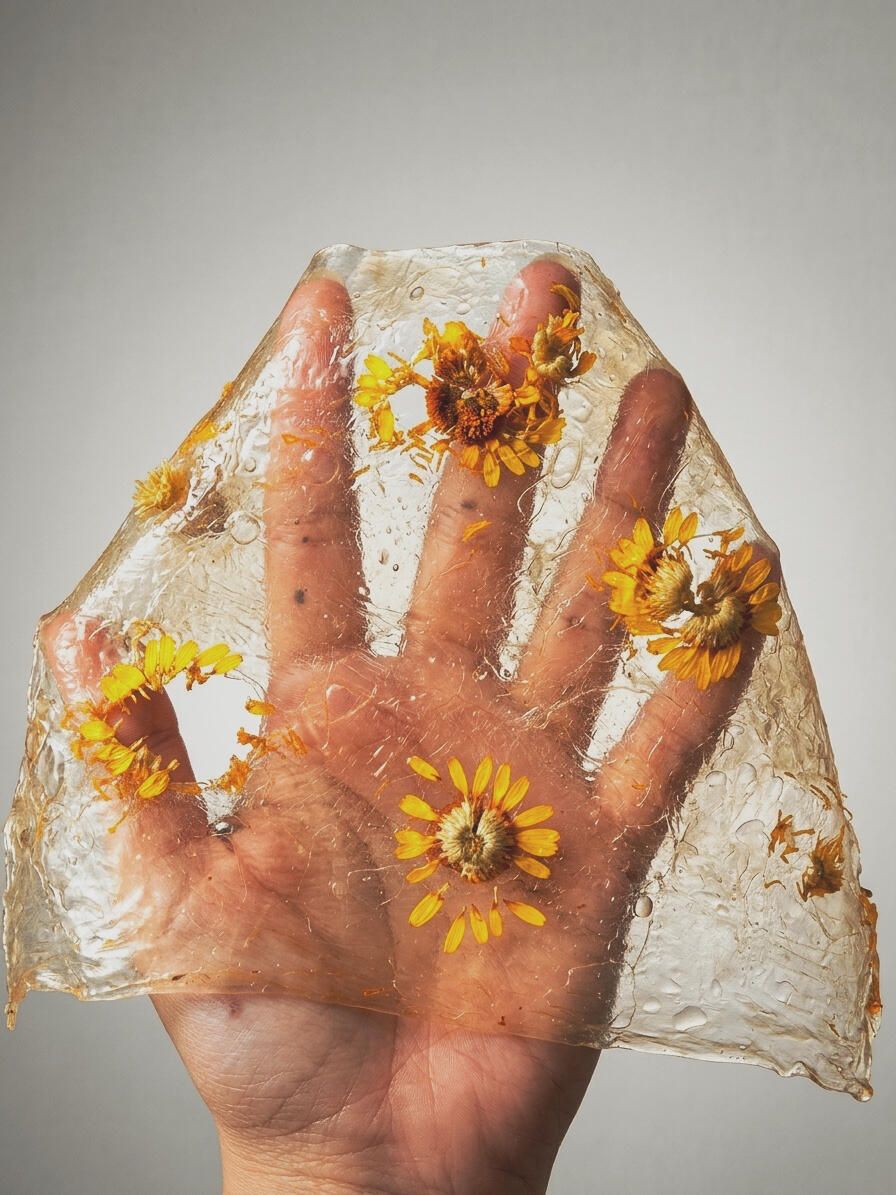
What can starch become beyond its familiar role in the kitchen?In our experiments, we explored how starches from different plants behave when transformed into solid materials. Tapioca, mung bean and taro produced variations in opacity, translucency and surface texture, while changes in formulation influenced the material’s rigidity, flexibility and tendency to crack. Some samples resembled plastic; others had a softer, clay-like character.These trials opened up possibilities for working with starch beyond flat sheets and film. Drawing inspiration from kerupuk, Indonesian crackers that expand and harden through cooking and drying, we began exploring how starch-based mixtures might form small, solid beads with translucent qualities.We use these experiments to investigate how plant sources and simple changes in preparation shape a material’s appearance and behaviour.